
Selective School Test Results Explained | Complete Parent Guide
Sat, 15 Aug 2026

Follow the stories of academics and their research expeditions
Every year around first term of the school, I start receiving the same questions from parents of Year 3 and Year 4 students.
“Is my child OC material?”
“When should we start preparing?”
“Are we already behind?”
“Is tutoring necessary?”
After teaching for many years and guiding students through the Opportunity Class placement process, I’ve come to realise something important: most families are not lacking effort — they’re lacking clarity.
This article is not written as advertising. It’s written as practical guidance from someone who has watched children succeed, struggle, grow in confidence, lose confidence, and sometimes surprise everyone — including themselves.
Let’s talk honestly about the OC test.
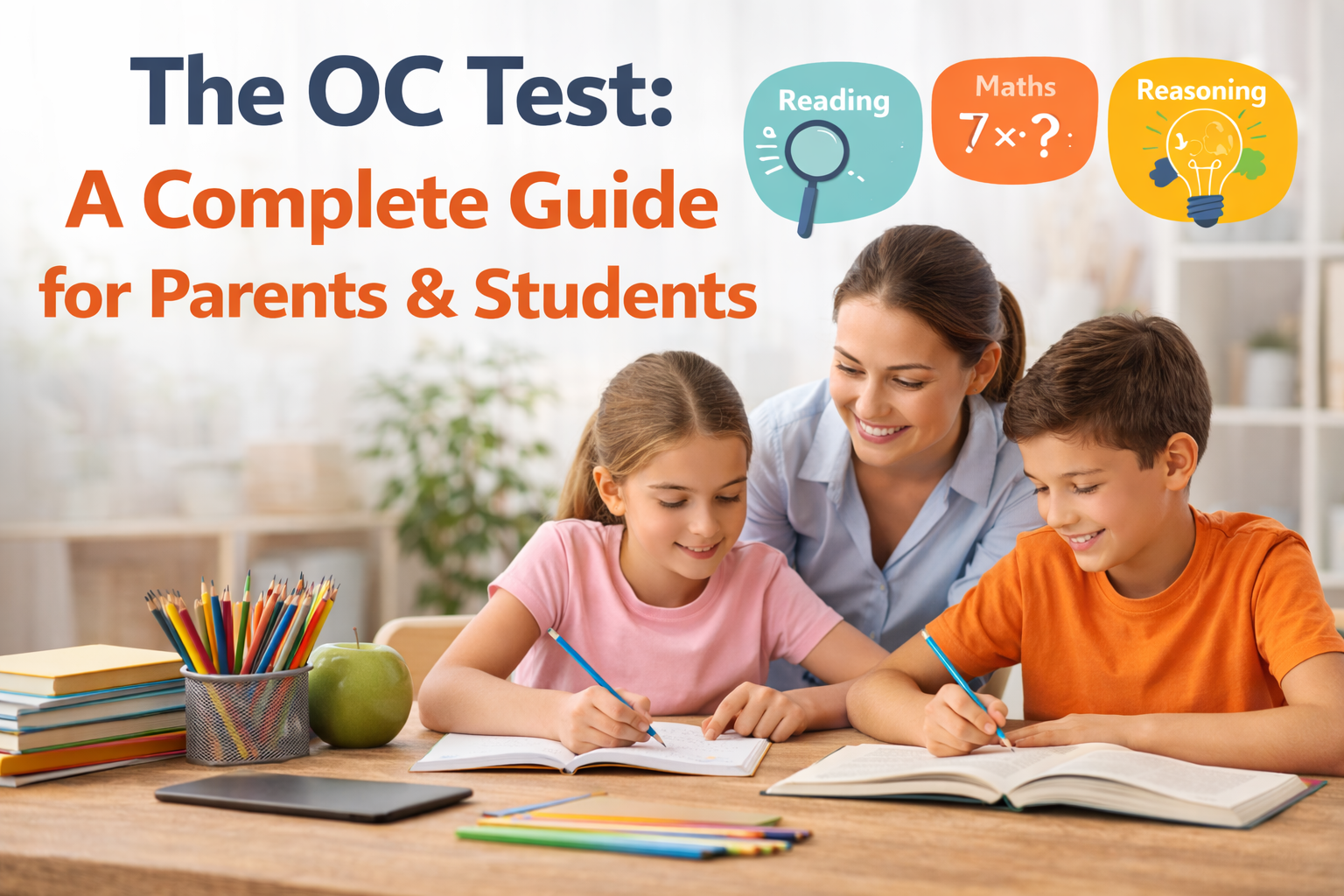
The Opportunity Class placement test is not a test of how well your child memorises school content. It is not a spelling competition. It is not a basic maths test.
At its core, the OC test measures how well a child can think.
It looks at how quickly and accurately a student can:
Understand written information,
Interpret meaning beyond the surface,
Solve unfamiliar mathematical problems,
Apply reasoning under time pressure.
This is why some straight-A students feel shocked after their first OC-style practice paper. The questions are not necessarily harder because the content is advanced — they are harder because they require flexible thinking.
One of the biggest adjustments for students is pacing.
In normal classroom settings, children are often given generous time. In the OC test, time moves quickly. Students must read efficiently, interpret precisely, and decide confidently.
I have seen capable students lose marks not because they didn’t know how to solve a question, but because they hesitated too long or second-guessed themselves.
The skill here is not rushing.
The skill is controlled decision-making.
That only develops with exposure and guided practice.
Parents often tell me, “My child loves reading. They read novels every night. So English should be fine.”
I wish it were that simple.
OC reading comprehension tests more than enjoyment of stories. It examines whether a student can:
Detect subtle tone shifts.
Understand why an author chose certain words.
Infer meaning that is not directly stated.
Compare ideas across paragraphs.
Identify assumptions.
Many strong readers initially struggle because they read for enjoyment, not for analysis.
That doesn’t mean they’re weak readers. It just means they haven’t yet trained their reading mind to dissect information under exam conditions.
This is a skill — and skills can be developed.
The mathematics in the OC test is rarely about complex calculations. It’s about approach.
Students might see problems involving numbers they recognise — but the path to the answer isn’t obvious. They must think creatively, eliminate possibilities, and sometimes work backwards.
The common mistake I see is this:
Children try to apply school-taught formulas immediately, even when the question requires a different way of thinking.
OC maths rewards flexibility.
The student who pauses to consider different strategies often outperforms the student who jumps straight into mechanical calculations.
This is one of the most misunderstood parts of the journey.
Starting extremely early with heavy pressure can backfire. Children burn out. They associate learning with stress.
Starting too late can create panic.
In my experience, the healthiest approach looks like this:
Year 3: Build strong reading habits. Encourage curiosity. Develop number sense.
Early Year 4: Introduce OC-style questions gradually. Let the child become familiar with the format.
Final months before the test:
Practise under timed conditions. Refine weak areas. Build exam stamina.
Consistency matters far more than intensity.
After observing many successful OC students, I’ve noticed patterns.
They are not always the loudest or the fastest in class.
But they tend to:
Reflect on their mistakes instead of ignoring them.
Stay calm when a question looks unfamiliar.
Avoid emotional reactions to difficult problems.
Maintain steady preparation habits.
Interestingly, confidence grows from familiarity.
When a student has seen dozens of question styles, very little feels surprising.
And surprise is often what causes anxiety in the exam room.
This part is rarely discussed openly.
Not every child who prepares will receive an offer.
Sometimes the difference between an offer and no offer can be just a few marks.
As a teacher, I’ve watched children flourish outside OC and later succeed in selective high schools or other pathways. I’ve also seen children enter OC and struggle because the environment didn’t suit them.
Opportunity Classes are beneficial for some students — particularly those who thrive on academic challenge and faster pacing.
But they are not a measure of intelligence or future success.
Parents play a crucial role here. The tone you set at home matters. If preparation feels like an opportunity for growth rather than a high-stakes judgment, your child will approach the test with far healthier confidence.
Practice is essential — but it must be purposeful.
Doing endless worksheets without reviewing mistakes carefully does little.
The real progress happens when a student:
Understands why they made an error,
Recognises patterns in their mistakes,
Adjusts their strategy for next time.
Structured, realistic practice that mirrors exam timing can help students build both skill and composure.
Exposure reduces fear.
If I could summarise everything I’ve learned from years of guiding students through the OC process, it would be this:
Focus on growth, not perfection.
Build thinking skills, not just speed.
Encourage curiosity, not anxiety.
Support resilience, not comparison.
The OC test is one milestone — not the destination.
If your child prepares steadily, reads widely, practises reasoning thoughtfully, and enters the exam room feeling calm rather than pressured, you have already done something valuable.
And that growth — regardless of outcome — will benefit them far beyond Year 5.
Sat, 15 Aug 2026
Sat, 21 Feb 2026


Prepare for selective school exams in Australia with Selective Test Pro. Offering OC & HAST practice tests, mock exams, and expert-designed study materials online.


Leave a comment